
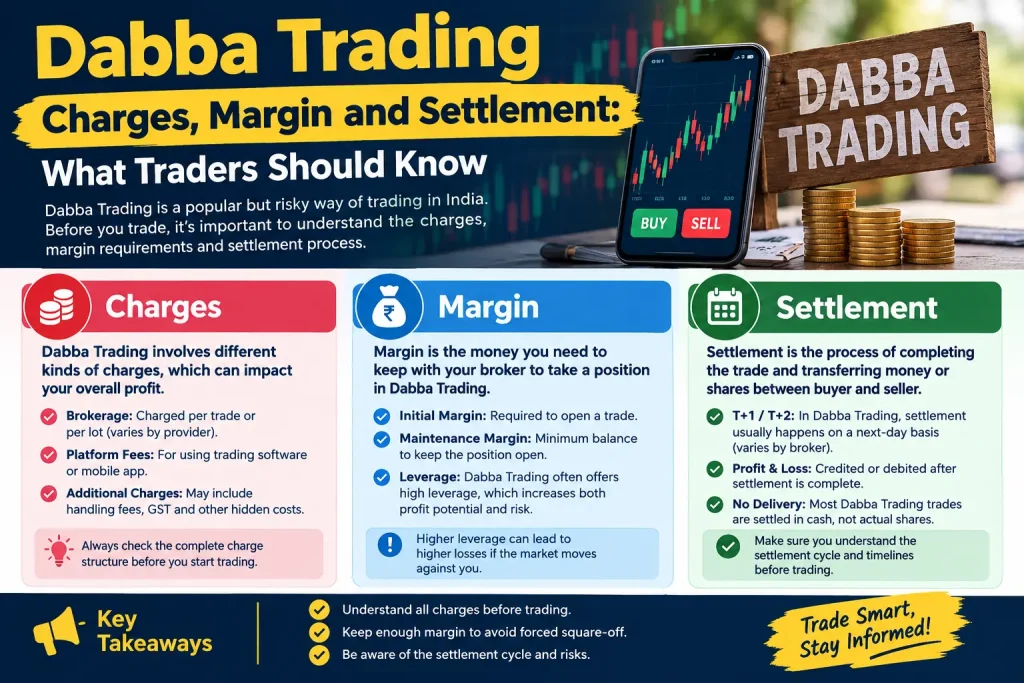
Dabba trading is the unauthorised form of trading where the transactions are recorded outside the official stock exchanges. Rather than placing the trade through a regulated broker, traders can deal with the operator who maintains the internal trade records.
The terms associated with dabba trading, such as the charges, margin, and settlement, work differently. You must understand these terms because dabba trading does not provide the same regulatory framework, investor protections, or standardised settlement mechanisms available through recognized exchanges and registered intermediaries.
What Are Dabba Trading Charges?
Dabba trading includes no formal regulatory charges, because traders can bypass the official stock exchanges completely. Rather than the standard exchange fees, traders can face various legal penalties and financial risks. You should be aware of the dabba trading charges before placing trades online. Below is a comparison of the regulated vs dabba trading charges
Financial Comparison: Regulated vs. Dabba Trading
| Feature / Fee Type | Regulated Exchanges (NSE/BSE) | Dabba Trading (Illegal Market) |
| Brokerage Fees | Standard flat or percentage fees | Advertised as “zero brokerage” or low commission |
| Statutory Taxes | STT, CTT, GST, and Stamp Duty mandatory | Completely evaded (No STT, GST, or income tax) |
| Account Costs | Demat and trading account opening/maintenance fees | No Demat account required (off-the-books tracking) |
| Hidden / Ultimate Cost | Transparent regulatory fees | Risk of total capital loss if the operator absconds |
How Does Margin Work in Dabba Trading?
Margin refers to the amount of money required to take a trading position. In regulated markets, margin requirements are governed by exchange and regulatory rules and vary according to the type of security, position, and market conditions. Dabba operators may provide their own margin arrangements. Some operators let the traders take the positions larger than the amount deposited.
For example, suppose the trader deposits ₹20,000 and is allowed to take a position worth ₹1,00,000. The trader controls the position five times the deposited amount. This is described as 5× leverage. Leverage can increase both gains and losses. A small movement in the underlying market can create a larger change in the trader’s position than the amount deposited.
Why Is High Margin Risky?
Higher leverage reduces the capital amount required to enter the position, but it increases the impact of market movement. Consider a simplified example.
- Amount deposited: ₹20,000
- Position size: ₹1,00,000
- Leverage: 5×
- Market movement against the position: 5%
A 5% adverse movement on a ₹1,00,000 position represents a ₹5,000 loss. That is equivalent to 25% of the ₹20,000 deposited. The actual terms provided by the operator can vary, and the example does not show a standard dabba-market margin requirement.
Is Dabba Trading Margin the Same as Broker Margin?
No, dabba trading margin is not the same as broker margin. A registered broker operates in a framework established by Indian securities market regulations and exchange rules. Risk controls, margin requirements, and processes are subject to applicable regulatory requirements.
In dabba trading, the arrangement lies between the operator and trader. The operator may decide how much exposure to give and when additional money is needed. This creates uncertainty about
- How margin is calculated
- When a position may be closed
- Whether additional funds are required
- How disputes are handled
- How losses are recorded
The absence of official exchange transactions means that traders do not get the same protections associated with regulated trading.
How does settlement work in dabba trading?
In the dabba trading system, settlement avoids using the formal exchanges and is performed completely in cash on an informal and trust-dependent basis.
Dabba trading, which is also called bucket shopping, takes place outside the regulated stock exchanges such as the National Stock Exchange of India (NSE). The transactions are not entered on official ledgers, and no real shares or commodities are exchanged.
Mechanisms of Dabba Settlement
Dabba trading operators (known as dabba trainers or operators) work in parallel economies that mimic real stock market price movements, but the settlement follows a distinct, off-market cycle:
- Cash-only transactions
All profits and losses (P&L) are settled either in cash or via unofficial banking channels. Because the whole system is designed to avoid taxes and escape regulatory supervision, there are no digital contract notes, no official receipts, and no demat account transfers.
- Weekly Settlement Cycles
Unlike the usual practice on trade days plus settlement days at regulated exchanges, dabba networks settle their accounts once a week (usually on weekends). The operator works out the net difference between the entry price and the exit price of the clients’ bets over the week.
- The Trust Factor
Because there is no legal clearing corporation to ensure that trades take place, the settlement is completely based on the personal trust, reputation, and local network of both the broker and the trader.
- Price Syncing
The settlement prices are directly based on the live feeds from legitimate exchanges. In the case where a trader “buys” a stock within the dabba at ₹100 and the actual market price ends up at ₹105, the operator will have to pay the trader ₹5 per share in cash at the time of settlement.
Example of Dabba Settlement
Suppose an operator records a trader’s position as follows as
| Particular | Amount |
| Opening position | ₹1,00,000 |
| Closing value | ₹1,05,000 |
| Difference | ₹5,000 |
| Recorded result | ₹5,000 gain |
In this simple example, the operator treats the amount of ₹5,000 as the trader’s profit. The calculation, record-keeping, and payments all rely on the operator; there is no official exchange settlement procedure associated with the transaction.
Conclusion
Dabba trading charges, margin requirements, and settlement procedures are not subject to the same exchange and regulatory framework as those applicable to genuine securities market transactions; they can vary. The operators are free to set their own commissions, leverage terms, and ways of calculating profits and losses.
The main problem is that a dabba trade does not have the same level of regulatory supervision, the same standardised clearing and settlement procedures, or the same investor protections that are available when trading through registered intermediaries and recognised exchanges.
It is important to understand how charges, margin and settlement work before looking at the risks involved in any trading arrangement outside the regulated market.
FAQs
What are dabba trading charges?
The charges involved in dabba trading are fees or commissions determined by the operator. Unlike in the case of regulated trading, they are not standardised by recognised exchanges or regulated brokerage systems.
How does margin work in dabba trading?
In dabba trading, margin is the amount of money you must keep with the dabba operator to trade. The operator sets the margin, which is usually lower than what official stock exchanges require.
Is dabba trading settlement regulated?
Dabba trading is usually settled using the records kept by the operator themselves, with profits or losses being determined on the basis of differences in price instead of by clearing and settlement on a recognised exchange.
Does a margin increase losses in dabba trading?
Yes, leverage can increase losses because traders can control larger positions with a smaller amount of capital deposited. Compared with the margin, even fairly small adverse price movements can lead to large losses.